Evers Knows Best
And Evers thinks we should bring on the big data center funders
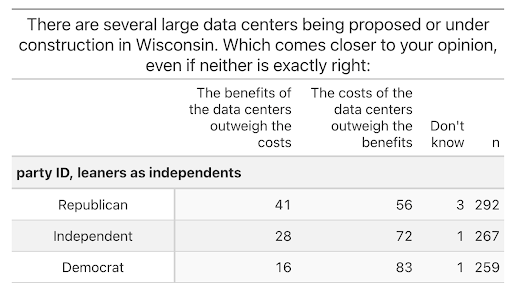
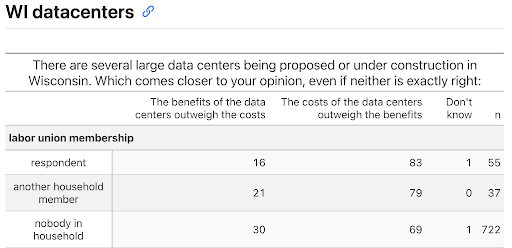
The black community on the North Side of Milwaukee is the heart of the Democratic Party in Wisconsin. Is that community asking for more data centers? Based on community reaction to this midtown development proposal the answer is emphatically no. Neither is the rest of the state according to the February Marquette poll where only 16% of Democrats and 16% of labor union members believe that “the benefits of the data centers outweigh the costs.”
Due to the regulatory inaction by state Republicans who neglected to enact an anti-NDA policy while in session, data center developers are able to move faster than the rate of regulation. Development is rapidly outpacing polled support for development. Democratic Governor Candidate David Crowley needs to specify exactly what he would and wouldn’t veto regarding statewide limitations on building hyperscale data centers. Saying he wants to “let communities decide” suggests he opposes statewide limitations.
Tony Evers praised data center developers in an interview a week after the primary saying that they are now being “more upfront.” By that he’s referring to how some developers are no longer using NDAs to shut out community comment as had happened five times by March of 2026.
Evers’ Big Data Friends
Two gifts to the Crowley campaign are marked as July 17th in the WEC’s Sunshine dataset. The 17th was the day before Crowley publicly announced he was re-entering the race and was also the day Sara Rodriguez dropped out of the race. One of the July 17th donations was $20,000 from Chris Abele. Is the son of the co-founder of Boston Scientific, a real estate investor, and was Milwaukee County Executive before Crowley. Abele also contributed hundreds of thousands to Crowley’s narrow victory in the County Executive race of 2020.
The other July 17th donation was $87,000 from the Wisconsin Laborers' District Council (LiUNA). LiUNA strongly supports hyperscale data center development. Why is this labor union so out-of-line with general labor union member polling?
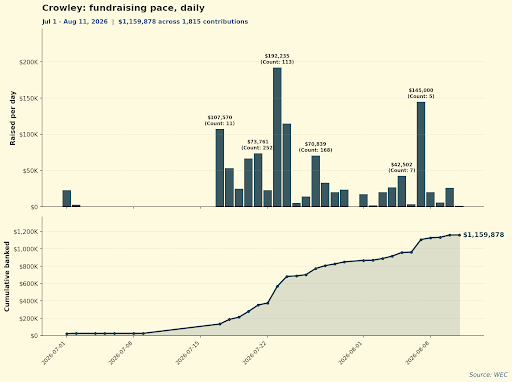
Other labor unions who stand to benefit from data center development and donated to Crowley after the 17th are International Brotherhood of Electrical Workers (IBEW) (wants data centers), Wisconsin Pipe Trades Association, International Union of Operating Engineers Local 139 (wants data centers), Wisconsin Carpenters, Steamfitters Local 601, Plumbers & Steamfitters Local 118, Plumbers and Steamfitters Local 400, Sprinkler Fitters Local 183, and Plumbers Local 75. Together these union endorsements since July 17th total $488,000.
How long will these union data center building jobs last after the AI Death Star is completed, or is it more of a one-time opportunity?
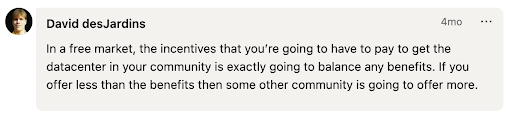
Outside of unions, many of the individuals who gave greater than $10,000 between July 17th and August 11th also have stakes in data center construction. These include Mara Wallace, wife of the CEO of KLA Industries; David desJardins, one of Google’s first 20 employees;
Scott Mayer of QPS Employment; Michelle Nettles of Manpower Group; and James Madlom and Lori Richards of Mueller Communications who did PR for both the Microsoft Racine data center and the Mount Pleasant Foxconn project. Adding to the $488,000 from unions we get $579,100. That $579,100 makes up 51% of the $1,133,793 in donations to Crowley’s campaign between July 17th and August 11th, according to the data in WEC Sunshine.
Prior to July 3rd, data centers represented a much smaller proportion of Crowley’s overall donations than after July 17th.
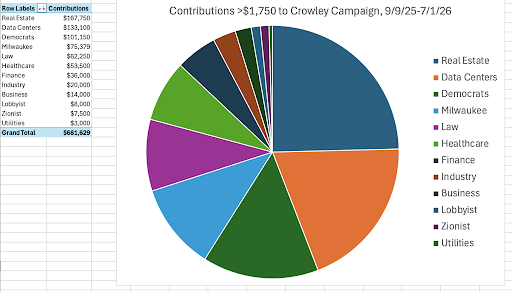
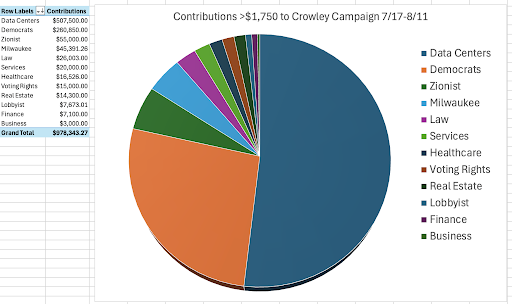
Additionally, dark money groups, claiming to be critical of data center construction dropped millions of dollars on the primary. Wisconsin Future Rising ran $1.9 million in attack ads against Hong and Believe in Wisconsin spent nearly $1 million with an ad touting Evers’ endorsement and arguing that Crowley would "crack down" on data centers. Yet it was the pro-data center LiUNA’s $87,000 donation that lead to Crowley re-entering the field.
What matters more to Evers: winning the general or data center donors?
For Democrats and others on the left who understand the importance of keeping Tom Tiffany out of the governor’s office, David Crowley’s weakness on data centers is frustrating and baffling. If over 50% of donations since he reentered the field are from groups who want to see data center construction, that may explain why he hasn’t taken a stronger stance. The bulk of the data center money came into play when Tony Evers brokered Crowley’s re-entry. Tony Evers did not veto a data center sales tax break and said “environmental concerns must be balanced with economic necessity and jobs for the future” as far as building data centers goes. This is a softer take than Crowley who has acknowledged that the number of long-term jobs is “smaller.”
Considering Tony Ever’s connections with LiUNA going back to 2022 and earlier, did he promote Crowley as the pro-data center Democrat candidate to unions to raise the funds that came the day before Crowley re-entered the race? Crowley did not make public statements on data centers in the announcement, so since his public stance was not much different than Kelda Roys’, how and why did these unions identify Crowley as the union-labor data center candidate?
In the primary, Tony Evers made the calculus that it was worth trashing a primary opponent in favor of getting Crowley elected. Evers saying that Hong has spent her “entire campaign dealing not with the issues but what’s on the Twitter” was justified because it was so important that a Republican didn’t win and Fran Hong had slightly worse odds even though all poll matchups against Tom Tiffany were within the margin of error.
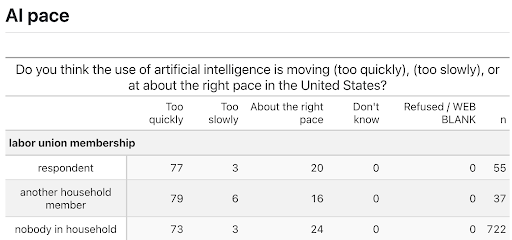
David Crowley has not said if he would veto a moratorium, but has said he is opposed to the idea. In an interview he’s said (2:12) that if AI were taking away jobs from young people that would be a “cause to pause” AI adoption. The “pause” language was used promotingSB1061 indicating he is familiar with proposed legislation. Yet 77% of union members surveyed in the same Marquette poll feel that AI is moving to fast. Why is that not sufficient cause to pause?
Democrat and labor support for data centers is below 15%, but neither Evers nor Crowley will make any critical comments about data center developers or commit to specific policies (vetoes). Weakness on statewide data center development regulation could cost Democrats the general, despite Tom Tiffany being worse on data centers and just as bought and sold.
If three points of polling was worth undermining another primary candidate in the name of winning the general, what else is worth sacrificing for the general? Would Crowley be willing to refund $500,000 to his data center donors to win back the grassroots support of the tens of thousands of Wisconsinites who Democrats lost when he beat Hong? Is massive well-organized volunteer canvassing worth any more than $579,100? Is Crowley even interested in finding out the answer to that question or does he just do what Evers tells him to do?
If the Democrats who supported Fran Hong don’t agree with the pro-data center approach, according to Evers, we “are just going to have to play along… I mean, not play along… be part of it.” Does Evers see data center development as non-negotiable to Wisconsin’s future? Perhaps more importantly, does Tony Evers think that funding from pro-data center groups is crucial to winning the November general? If so, Crowley would do well to distance himself as much as possible from the current Governor who thinks he knows what’s best for the state even if his party and constituents are begging for an alternative.
Democrats like to remind us that Tom Tiffany and the Republicans voted for opening up over 225,000 acres of the Boundary Waters for low-grade copper extraction. They want us to get in-line on electing a Democrat this November to protect the Boundary Waters, but if environmental concerns are up for negotiation when it comes to making money, as Evers has made clear it is, how can we say they are representing Democrats? If the highest-ranking Democrat in Wisconsin disregards public opinion on data centers like he disregarded one of Wisconsin’s most remarkable progressive grassroots campaigns in the Frang Hong campaign, how can we say he is representing the people of Wisconsin or the party initial after his name?
Data center construction is one of the biggest issues of the 2026 governor race, and as Tiffany already loves to point out, Crowley’s donor list makes it very hard for him to respond to the clear public outcry and demand for regulation. If we do have Tony Evers to thank for that, then the candidate would do well to distance himself from the current office-holder. In the primary we had a massive upset where the winning candidate’s votes did not match what polls predicted. If the polls are similarly wrong in the general like they were in the primary, and like they were in 2024 when Trump was elected, then electability truly does matter and we cannot afford to ignore public opinion on data centers in the name of a half million dollars for ad buys.