Fighting for Democracy in Senate District 17
We hear a lot about the fight for democracy these days. Generally, that means a fight against Trump and other billionaire pedophiles and sycophantic cronies. Unfortunately, here in Wisconsin during the primary season, we also need to fight against Democratic leaders to protect voter sovereignty.
A few weeks ago, we shared the story of Greta Neubauer and the Assembly Democratic Campaign Committee (ADCC) applying pressure to push out a candidate in Southern Milwaukee and Oak Creek (AD21). Now we’ve got a similar story about Diane Hesselbein and the State Senate Democratic Committee (SSDC) trying to push out a candidate in the southwest corner of the state (SD17). This time, that candidate is Corrine Hendrickson.
She’s not budging, and she was happy to tell us her story.
Background on SD17
Senate District 17 includes Wisconsin’s mostly rural Southwest corner. Republican Howard Marklein has been Senator there since 2015. Marklein grew up on a Spring Green dairy farm, but in 1974 he started working in international finance and accounting. In office, Marklein leveraged those skills to get on the powerful Joint Finance Committee. Since 2017, he has used that position to impose austerity on working people while cutting taxes for the rich.
Before running for State Senate, Marklein was elected to the State Assembly in 2010. He helped rig the maps so that he could not lose. Under new maps, SD17 actually leans blue, so this year will be the first time since 2010 that Marklein faces anything like a fair fight. Those new maps spurred a lot of interest. Early on, nine people were publicly considering a run. Hendrickson told us that in previous cycles the county and state party struggled to find anyone willing to challenge Marklein in his crooked district, so county party chairs were excited by all the interest. County leaders gathered the potential candidates together, and planned a series of forums to introduce them to voters. These forums would also give candidates a taste of running, to help them decide whether or not to get in.
Meanwhile, some party leaders had other ideas. Hendrickson recounted an early meeting in May where party leaders from outside SD17, “tried to convince us that a primary was bad, and that we should self-select ourselves out.” Hendrickson says locals in the audience “very firmly rejected that idea”. She described the vibe as, “we didn’t fight this hard for fair maps to be told who we get to vote for.” Other candidates and County Party Chairs have shared similar thoughts with Wisconsin Examiner, and one also wrote an op ed about his experience.
Dianne Hesselbein, Senate Minority Leader and head of the State Senate Democratic Committee (SSDC) took a lead role in discouraging primary candidates. Around June 30, amidst intense budget negotiations, where she led the compromise, Hesselbein called the potential SD17 candidates, telling all but her favorite to drop out of the race. This was nearly two weeks before the first of the county party forums that voters and party members in the district had enthusiastically organized. “Hesselbein told me it would be really hard to win if you don’t have the backing of SSDC,” Hendrickson told us, “and that SSDC would be endorsing Jenna Jacobson.”
A Childcare Worker with Guts
Corrine Hendrickson used to run a family childcare center. When COVID-era subsidies were set to run out, driving up childcare costs and jeopardizing providers, Hendrickson knew better than to trust the process. As co-founder of the Wisconsin Early Childhood Action Needed (WECAN), she organized members to take direct action at the capital. They faced off with Republican legislators, demanded Governor Evers veto any budget that didn’t provide childcare subsidies, and organized a childcare worker strike. Evers and other Democratic party leaders then helped Republicans pass a budget with a net reduction in childcare support.
Hendrickson closed her child care. She told us she knew during the budget fight that she could not afford to operate if Evers signed that budget. At that point, Hendrickson recognized something that more and more of us are recognizing these days: when the political economy is rigged against us, when our elected officials represent wealthy elites instead of us, then it's time to take action into our own hands and replace those elected officials.
Senator Howard Marklein played a key role in taking away Hendrickson’s livelihood, in reducing the childcare options for her neighbors and clients, and generally making life in Wisconsin less affordable. In response, Hendrickson wanted to play a key role in ending his malignant, corrupt, undeserved career as a State Senator. But, she knew it wasn’t her call alone. She needed to earn the support of voters to take the role of defeating Marklein, so she went to work. She attended meetings in every county party in the district, met other candidates interested in running for the seat, and began organizing her campaign.
With his history of cutting budgets and serving the rich, Marklein would be an easy target for the left populist message we support, and that Corrine Hendrickson offers. If she wins, Hendrickson will be the only State Senator with an education degree. Her background in special education and mental health treatment also make her uniquely qualified for the social crises Wisconsin faces. Unfortunately, Wisconsin Democrats’ bumbling centrist leadership is instead pushing Jenna Jacobson, a politician with a background in finance who voted with Republicans on ALEC sponsored legislation to limit criticism of genocide.
I spoke with Will Karcz, the communications director for SSDC. He said a number of things about how flippable the Wisconsin State Senate is, and how they are going to make it happen with their chosen candidates. When asked about SSDC’s apparent opposition to primaries, he said “there’s nothing the SSDC can do that would stop Democrats from having a primary” and that they, “believe Jenna Jacobson is the strongest general election candidate.” When pressed, he described her traveling the district, and focusing on affordability, things that would be true of any serious candidate. The only qualifications he could articulate that were unique to Jacobson is that she has won in the past; that she worked hard representing AD50, and the town of Oregon before that. He was unable to describe the process by which SSDC makes endorsement decisions and deflected questions about why they chose to put their weight behind one candidate so early in the race.
We also contacted the Jenna Jacobson campaign, but were unable to schedule an interview before the time of publication.
Candidate comparison
On the June 30 call, Hendrickson asked Hesselbein why they picked Jacobson, and Hesselbein’s answer was the same she later told journalists, simply, “because we know her.” Jacobson wasn’t favored for being more electable, more popular in the district, or somehow better qualified, but only for being more familiar to SSDC leadership. Actually, not just familiar, more like friendly, because Hesselbein does know Hendrickson; she he knows her as an uncompromising fighter demanding more of Democratic leadership.
After hearing about the endorsement, Hendrickson asked Hesselbein to talk about the budget. When she learned that Hesselbein would be helping Republicans pass a budget that shrinks childcare support, and that Evers would sign that budget, Hendrickson asked Hesselbein “to not pretend that it’s a good thing.” In that regard, Hesselbein did better than Evers whose misleading celebration led Hendrickson to write a response which we published.
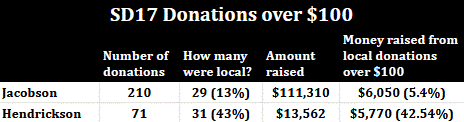
These stories make it clear that Hendrickson is the more activist candidate. Looking at finance reports, it's just as clear that Jacobson is the better-funded candidate. Jacobson raised $118,143, while Hendrickson raised $15,684, but that top line number is far from the whole story. Remember, it is people who win elections, not money. If the bulk of the money comes from a small number of large donors or from donors who do not live in the district, and therefore cannot vote in the race, then it provides significantly less insight. Let’s dig in!
First, Jacobson got $25,000 from SSDC. Second, the campaign committees of Senators Kelda Roys, Mark Spreitzer, Diane Hesselbein, LaTonya Johnson, Kristen Alfheim, Brad Pfaff, Jodi Emerson, Jamie Wall, all maxed out with $2000 contributions, as did Hesselbein staff member Melissa Mulliken, the new WI Economic Development Corporation Secretary John Miller, and six members of the zionist Lubar family of Milwaukee. Milwaukee area Senators Dora Drake and Deb Andraca also gave. That’s more than $58,000 directly from SSDC’s endorsement. Meanwhile, Hendrickson’s initial donor base comes from child care provider networks.
We also checked cities for the donations of $100 or more each candidate got, and compared them. Only 5.4% ($6,050) of funds from Jacobson’s donations over $100 came from people in the district, while 42.5% ($5,770) of Hendrickson’s did. Hendrickson started fundraising in September, two months after Jacobson, and without the jump start and free publicity of SSDC’s support.
Taking all these factors into account, this primary will be far more competitive than it might seem from outside. We just wish Hesselbein and SSDC had saved their money. They could have used it in the general election for the candidate that Democratic voters in SD17 picked off a level playing field to take on Marklein and represent them.