Governor Race Finance reports first impressions
Wisconsin campaign finance reports hit the internet late last Thursday, allowing the public some insight into who is helping finance which campaigns. In our late-stage financialized capitalist upside-down hell world, pundits and consultants have turned the legalized bribery of campaign finance into a virtue and qualification for candidate success. They want us to believe that whoever raised the most money is the best candidate. That’s not true.
As we’ve described before, the truth of campaign finance is that it heavily influences candidates, but barely moves voters. That’s why the Wisconsin Democratic Party Membership has passed party resolutions (22-JHD-13, 25-JHD-01) denouncing big money in government, and demanding reform. Campaigns do need a base level of funding to inform voters of their candidate’s name and positions, but beyond that, campaign spending mostly enriches consultants and buys saturation outreach to annoy people more than convince them. A campaign that mobilizes volunteers and organic enthusiasm needs money even less.
Campaign finance reports serve two other important purposes, though. First, they help track influence. This glimpse into finances allows us to, y’know, see the bribery happening. This requires a deep examination of particular funding sources, more work than an all volunteer project like ours can do in less than a week. Be patient. It’s coming.
Another use for finance reports is prediction. Marquette has not done a poll since October, when 81% of respondents were undecided, and no Democratic Party candidate got more than 6%. Polling is also notoriously unreliable, so we can use donations as a proxy for votes to help predict an election outcome. It’s not perfect, and we’re still a long way from August, but right now, the finance reports are probably our best tool for trying to soothsay this election.
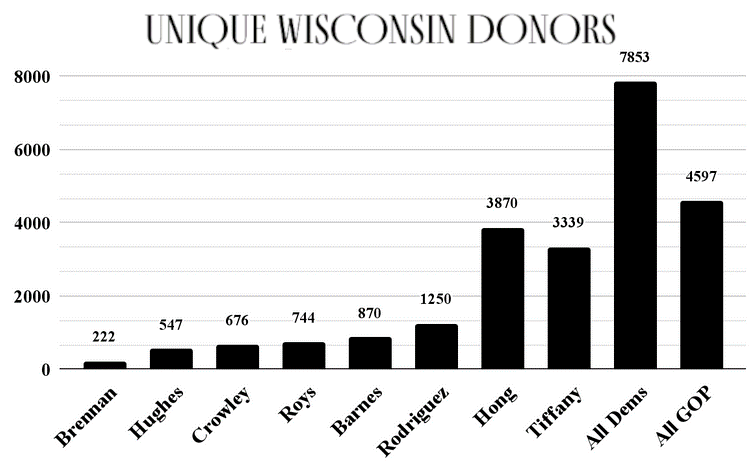
Of course, total funds raised is a poor proxy for votes. A candidate who gets tons of money from a small number of rich people maxing out, or from out-of-state donors does not necessarily have support from those who can actually cast votes. Instead, you want to look at how many people from Wisconsin are making small and mid-size donations. When you do, Fran Hong is far ahead of the pack.
These numbers tell other interesting stories. We’ll continue digging into the data, but want to get something out this week, so here are a few quick first look insights.
Insight 1: Fran Hong is Definitely Winning
Money doesn’t vote, people do. If we count unique donors, rather than total raised, or total number of donations, and exclude donors from out of state, we get a better proxy for voters. If every Wisconsin donor was a voter in the party primary, Fran won nearly half (49.5%) of them! These numbers are not perfect, as some people gave to more than one candidate, and some non-voting residents may have given to campaigns, but, unique contributors from Wisconsin are a far better proxy for the electorate than total raised, and Fran is absolutely dominating. She also has Tom Tiffany beat single handedly, and all Democrats combined are whooping the Republicans combined.
Insight 2: The Really Rich Donors.
The maximum an individual can give to a campaign is $20,000. You have to be pretty wealthy to give more than $10,000. Unsurprisingly, Republican front runner Tom Tiffany relied most on those, but some Democrats were not far behind.
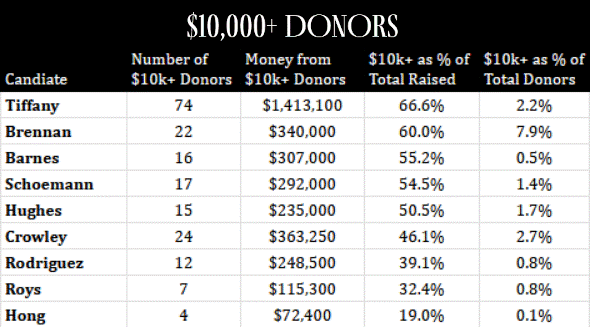
These donors include Milwaukee’s greediest real estate developers and Wisconsin’s corporate elites. Some gave huge sums to multiple candidates. Remember, campaign funds don’t have a strong influence on the outcomes of races, but they do have a strong influence on candidates, both during the race, and while in office. A rich donor giving thousands to multiple candidates is hoping to have sway with whoever wins. Thoroughly examining these specific donors is the real work we’ll do in a future article.
Insight 3: What is Joel Brennan doing here?
Joel Brennan was the last person to join the race. Among Democrats, he has the smallest number of donors and the heaviest reliance on larger donors (93% gave more than $1,000). He’s also the only white man in the Democratic primary. Saying this more definitively requires research, but the confluence of these facts smells like liberal racism and sexism. Did some traditional big-donor Democrats hold back their support because they believe (erroneously) that Wisconsin will only elect a white man? Did Brennan join the race to pry open their pocketbooks? We’ll dig in, stay tuned to find out!
Insight 4: Wisconsin does not want Mandela Barnes.
Fully 75% of the money Mandela Barnes raised came from out of state. Only Joel Brennen relied more on donors giving $10,000 or more. Barnes also gets a higher percentage of his reported money from PACs than any other candidates, including the one he founded, which also spends more money on paying itself than on supporting candidates. We can’t quite say this is a vanity campaign, but as we’ve described in the past, Mandela Barnes does not seem to be running because the people of Wisconsin want him to.
Insight 5: David Crowley is having it both ways
Including money he rolled over from his County Executive fund, David Crowley leads the Democrats on total raised, but he comes second to last after Brennan for small dollar donations, in both number of donors and amount raised. He talks about affordability, especially about affordable housing, but among his top donors are the people making housing more expensive, and wages lower.
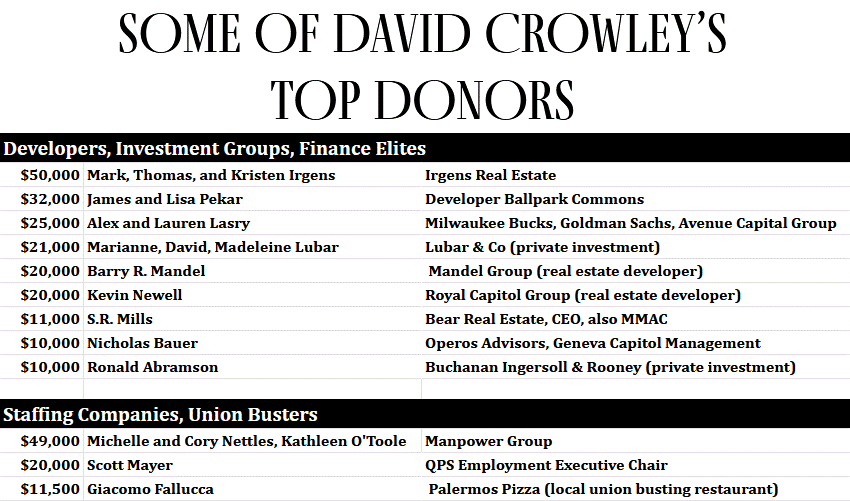
We intend to do a breakdown like this for every candidate, but Crowley’s the top of the pack, so he goes first! He’s also got the most distance between words and actions. On affordable housing, he tried to kill Milwaukee County’s right to council program, which defends thousands of people from unjust evictions. Crowley is running on being the one to fix shared revenue, even though he was a key pusher of the bad deal. He talks about transportation infrastructure while cutting funds for MIlwaukee buses. It's a real Jekyll and Hyde situation here, and hopefully as people start thinking and looking more critically, they’ll understand that Crowley is not the friend he tries to seem.
Insight 5: Does Kelda Roys have a lane?
Kelda Roys lost the 2018 primary to Tony Evers because she and Mahlon Mitchell split the progressive vote, and because (as we explored here) some conservatives exploited Wisconsin’s open primary system to back Evers. She stood up to Evers when he undermined the state senate’s leverage and passed his fourth conservative budget. Her talking points, activities in office, and policy page look better than anyone except Hong’s, but she’s lagging behind on fundraising and enthusiasm.
Roys raised significantly less money than anyone else in the race. Also, her largest donor is herself. Her husband also maxed out for her, as did his co-worker at American Family Insurance, Peter Gunder, and his wife. That’s four friends making up more than $80,000 of Roys’ $355,000. We imagine she hoped small donors on the left, especially in her hometown of Madison, would also back her up, but with an actual socialist in the race, why should they?
Insight 6: The Centrist Split
Sara Rodriguez, Missy Hughes, and Joel Brennan are all coming out of the Evers administration. They are all pro-business, corporate elites, and always have been. Like their boss, they’ll appease hardcore Republicans to court the mythical swing conservative, all to put bipartisanship over doing what’s right. Mandela Barnes and David Crowley have roots in Milwaukee’s working class, but they too have moved hard to the center, so they’re competing with the other three for the same rich donors and the same fearful conservative voters.
If we deploy our “unique Wisconsin donors as a proxy for votes” heuristic here, and nothing else changes, all five of these centrists, plus half of Roys’ donors would need to consolidate behind one candidate to beat the Hong powerhouse.
It’s an exciting time to be a socialist in Wisconsin, folks!