Candidate Answers: Lisa White SD17
We sent all candidates for the state legislature with contested primary races a set of questions. We are publishing their responses as we receive them.
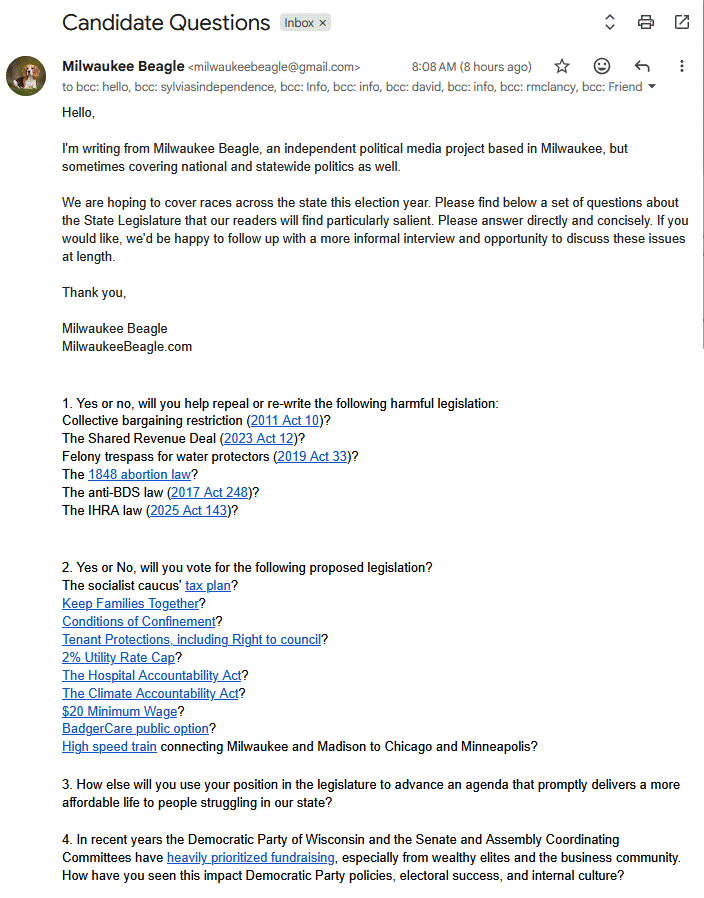
Here’s responses from Lisa White, who is running in State Senate District 17. SD17 is in southwest Wisconsin. It leans slightly blue (+1 Democratic) but is currently held by Republican Howard Marklein.
We wrote a little about White and her competition back in May, and about party insiders trying to prevent a primary there. Old Dan reccomends another candidate in that race, but we do like White’s answers here. You can read more about White by visiting her campaign website.
The Questionnaire
1. Yes or no, will you help repeal or re-write the following harmful legislation:
Collective bargaining restriction (2011 Act 10)?
Yes.
The Shared Revenue Deal (2023 Act 12)?
Yes.
Felony trespass for water protectors (2019 Act 33)?
Yes.
The 1848 abortion law?
Yes.
The anti-BDS law (2017 Act 248)?
Yes.
The IHRA law (2025 Act 143)?
Yes.
2. Yes or No, will you vote for the following proposed legislation?
The socialist caucus' tax plan?
Yes.
Yes.
Yes.
Tenant Protections, including Right to council?
Yes.
Yes.
The Hospital Accountability Act?
Yes.
The Climate Accountability Act?
Yes.
SUPPORT RAISING, exact figure to be determined. I support raising Wisconsin's minimum wage. The current minimum wage has not kept pace with the cost of living, and no one who works hard should struggle to meet their basic needs.
That said, I do not currently support an across-the-board increase to $20 per hour. While that may be appropriate for some industries or regions, I believe it could place significant strain on small businesses and reduce opportunities for entry-level workers, including many teenagers gaining their first job experience.
I support increasing the minimum wage to at least $15 per hour while continuing to evaluate economic conditions and regional differences. We should also recognize that tipped employees and certain industries have unique circumstances that deserve thoughtful consideration. My goal is to raise wages in a way that improves workers' lives while keeping Wisconsin businesses strong and preserving opportunities for those entering the workforce.
Yes.
High speed train connecting Milwaukee and Madison to Chicago and Minneapolis?
Yes.
3. How else will you use your position in the legislature to advance an agenda that promptly delivers a more affordable life to people struggling in our state?
Fix school funding and deliver property tax relief. I will fight for a fair, transparent school funding formula that increases state support, reduces the burden on local property taxpayers, and sends public dollars back into our neighborhood schools instead of vouchers. This is how we protect kids’ education and make it easier for families, seniors, and small business owners to afford to stay in their homes.
End the voucher drain and reinvest in public schools. I will work to phase out the school voucher program in a responsible way and reinvest those funds in local public schools, especially in rural and small‑town districts that have been stretched thin. Every child deserves a strong, well‑resourced public school in their community, and every taxpayer deserves accountability for how their money is spent.
Modernize zoning so communities can build affordable homes. I will push to update zoning and land‑use laws so communities can build more “missing middle” housing like starter homes, duplexes, and small multi‑unit buildings, instead of only high‑end or sprawling development. By removing outdated barriers, we can lower housing costs, reduce long commutes, and keep younger families and workers in our communities.
Expand low‑interest and first‑time homebuyer tools. I will champion low‑interest loans, down‑payment assistance, and first‑time homebuyer programs focused on working families and rural residents, so more people can move from renting to owning and build long‑term stability. Helping people buy modest, affordable homes is one of the fastest ways to make life more secure and affordable for the next generation.
4. In recent years the Democratic Party of Wisconsin and the Senate and Assembly Coordinating Committees have heavily prioritized fundraising, especially from wealthy elites and the business community. How have you seen this impact Democratic Party policies, electoral success, and internal culture?
The heavy prioritization of big‑money fundraising has, in my view, distorted Democratic policies, weakened trust in our elections, and pulled the party’s internal culture away from real grassroots democracy. Since Citizens United and other Supreme Court decisions opened the door to virtually unlimited outside spending and dark money, wealthy elites, PACs, and lobbyists have gained an outsized grip on our politics. When those forces are treated as the key to “viability,” candidates become effectively beholden to their interests, and ordinary working people are pushed to the sidelines. Tying electability to cash‑on‑hand is, to me, an absolute bastardization of democracy, and my own experience as an underdog—shut out and undermined by an early, 11‑month endorsement from the state senate Democratic committee—shows how this can tilt the scales against community‑driven campaigns before voters even have their say.
Despite that early endorsement and the money behind it, my values would not allow me to sit this out or stay silent. I felt a deep obligation to bring this message directly to our constituents, even knowing it put me at odds with insiders and made a “favorable” outcome for me less likely. That only made me more determined to stay in this race and fight like hell for a more democratic, transparent, and truly people‑powered politics in Wisconsin—one where candidates are measured by their integrity, their work in the community, and broad, small‑dollar support from many everyday people, not by a handful of giant checks from wealthy donors or unbridled outside spending unleashed by the courts.