A Financial Guide to Legislative Primaries
The primary election is tomorrow. For anyone still uncertain about some key primaries in the state, we’ve put together top level financial snapshots. Just looking at the money will often help determine who is backed by people power vs wealthy elites. If we were more of a serious news source, or less invested in volunteering for our favorite candidates, we would be publishing this article prior to today. But hey, better late than never.
In my analysis, those backed by people power rather than donors are both more likely to win the general, and to have better policies in office. I also believe that offering the people of Wisconsin permanent affordability will deal fascist creep Republicans a more permanent defeat.
We have covered all these races previously, in either our congressional primer, and articles on primaries in Republican held districts, and primaries in Democrat held districts. The Recombobulation Area recently listed all the districts and their partisan leans, but gave no opinions or details on the race. In this article, we’re just going to look at the finance reports for these races and offer some hot takes. Read the links for a more holistic picture.
Notes on method:
I listed money that candidates donated to their own campaigns separately as it often skewed averages, especially for lower-raising campaigns.
Some candidates announced later than others and some incumbents had roll-over from previous races, so in order to compare apples to apples, we are including data from July 1, 2025 to July 31, 2026 in state legislative races, and January 1, 2025 to July 31, 2026 in Congressionals.
I am listing the races in order of attention I feel they deserve, considering a balance of both the closeness of the contest, and the stakes of the race. I am relying heavily on my gut in these decisions.
References without links are to data acquired from the state and federal campaign finance reporting websites.
We are unpaid amateurs and are relying on data compilation done by a very helpful volunteer. We did our best to capture everything and present an accurate picture of these numbers, but want to apologize in advance if we missed anything. The Federal Election Commission website for Congressional races is especially not user-friendly, so please double check other sources and treat this article as general impressions, not a strict accounting.
State Senate and Assembly Races
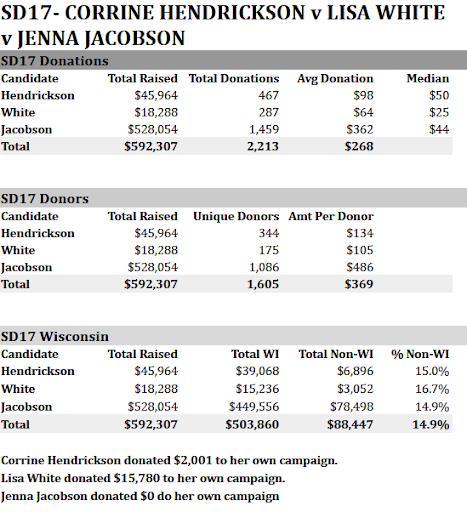
The Senate District 17 primary is a clear race of grassroots people power vs establishment money, which I first wrote about months ago. The State Senate Democratic Campaign (SSDC) endorsement brought Jenna Jacobson $351,351 directly, and another $19,000 chipped in by various Senators’ campaign funds. She also received $12,000 from six people with the last name Lubar, a family closely tied to and also supporting the racist Milwaukee Jewish Federation, an organization notorious for funding ethnic cleansing in the West Bank. The Lubars and Jewish Fed are basically Wisconsin’s AIPAC. They’re likely rewarding Jacobson for voting with Republicans and ALEC on the pro-war, anti-free speech IHRA legislation.
In her previous post in the State Assembly, Jacobson described herself as the most bipartisan representative, and fascist organization Turning Point USA gave her the 3rd highest score among state Democrats. Jacobson’s largest expense is a $438,591 TV ad buy. News from in the district is that Jacobson also had to pay people to collect signatures, so we checked and found that 55 of the 99 pages were certified by Orion Danou, of Madison, who may also be Jacobson’s campaign manager. There are a handful of other certifiers also from Madison, and outside Jacobson’s district.
I have been impressed with Jacobson’s lead opponent, Corrine Hendrickson, ever since she and other childcare workers stood up to Tony Evers over letting Republicans cut childcare from the state budget. Hendrickson has great fundraising numbers for a fully grassroots campaign, and it sounds like she has the ground game to match. Unfortunately, Wisconsin has not moved to allow ranked choice voting in the primaries, so the fact that there are two candidates running against the establishment pick (see Lisa White’s answers to our questionnaire) makes it harder for either of them to win.
In short, the SSDC is propping up a candidate with unpopular policy positions to run a widely hated, and often unsuccessful, Republican-lite strategy. If Jacobson wins, it is going to be hard to turn her TV money and name recognition into the enthusiastic grassroots ground game needed to beat incumbent Republican Howard Marklein. If she does get into the State Senate, I’m afraid she’ll come seeking opportunities to waste the trifecta on bipartisan compromise.
Meanwhile, Hendrickson’s ground game with some WISDEMS backing would defeat Marklein easily. As an activist, we can also trust her to focus on delivering for the working class in the State Senate.
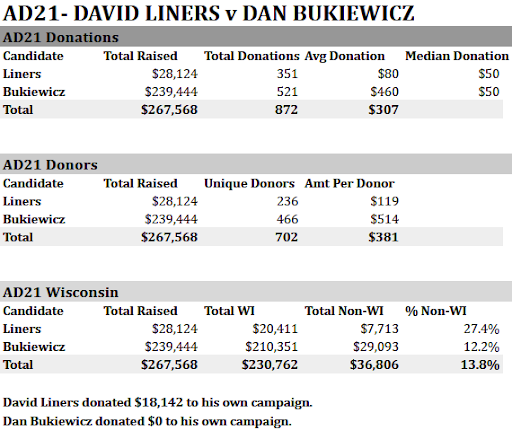
This is the race where the Assembly Democratic Campaign Committee (ADCC) pushed out Jessica Seawright because they didn’t think a native woman who was a social worker would be able to win in Oak Creek. They then dumped $202,927 into their chosen white man: Oak Creek Mayor Dan Bukiewicz. Looking into Bukiewicz’s financials we see he also got a lot of his other money (at least $19,000) from the building trades, who want him to secure short-term jobs building data centers at the expense of all other workers. He spent $184,044 (76.8%) of his money on consultants. It probably costs that much to do damage control for someone who appeared in DataCentre magazine. Bukiewicz also received at least $1,250 from genocide freaks (Ann Jacobs and Marianne Lubar.)
Between his elite party-insider astroturf support and the stain of data centers, Bukiewicz is a sure liability going into the general election. If he manages to win, he would be a conservative anchor, slowing down the Democratic trifecta and enabling Republican retrenchment in 2028.
Fortunately, Democrats in AD21 have a great alternative in David Liners, who is operating with far less money, most of which came from his own pocket. As a retired pastor and organizer with WISDOM, Liners contribution to his own campaign clearly comes from passion for policy, not vanity or excess. He only got in the race after Seawright, who he was knocking doors for, got pushed out. His primary expenses are a campaign manager (Steven Daw, a known and trusted community organizer) and online advertising. They appear to be putting up an impressive ground game, which they can multiply in the general election with some backing from WISDEMS.
Liners has the endorsement of Wisconsin Electoral Socialists, Fran Hong, Chris Larsen, and Ryan Clancy, a deep knowledge of the problems with Wisconsin’s prison system, and a genial demeanor. He will be a powerful asset in a Democratic trifecta. The values and policy contrast between him and Bukiewicz is huge, but because of the massive money gap, I fear this race will be very close.
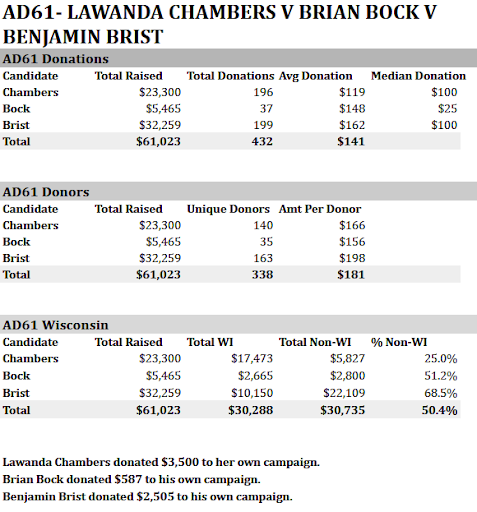
AD61 is an important race because the district leans Democrat but has been successfully held by weird bootlicking clown-puncher Bob Donovan for a few cycles. It is also an opportunity to show that candidates with a history of service and compassion like Lawanda Chambers are a better bet than Republican-lite moderates like Ben Brist.
Chambers got $1,500 from Supreme Moore and LaTonya Johnson, while Brist received $250, $150, and $100 respectively from genocide freaks Ann Jacobs, Sheldon Wasserman, and Dustin Klein. Also, a far greater number of Brist’s donations come from out of state than Chambers’, which Brist claims Republicans have seized on because they don’t want him to win the primary. The subtext many will take from his video, after two cycles of Donovan beating Bird, is that only a white man who is an army vet can defeat Donovan. Just because the Republicans are attacking him for out-of-state donations doesn’t mean it’s not true. Many of his $500+ donors who are from Wisconsin are from Madison, Fitchburg, Racine, and other areas outside of District 61.
Bob Donovan narrowly defeated Luann Bird in 2024 when the massive Biden-Harris fuckup depressed Democrats down-ballot across the state. This year, enthusiasm for left populist Democrats is going to buoy candidates like Chambers to beat Donovan, while the unpopular party establishment weighs Brist down. Chambers is the safer bet, and in office she will carry forward her direct experience counseling the most vulnerable people in the state to deliver the full promise of the trifecta.
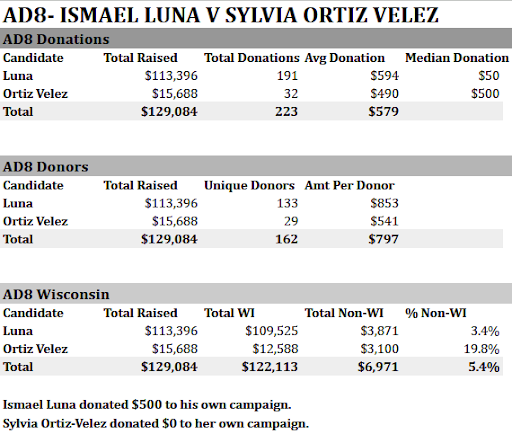
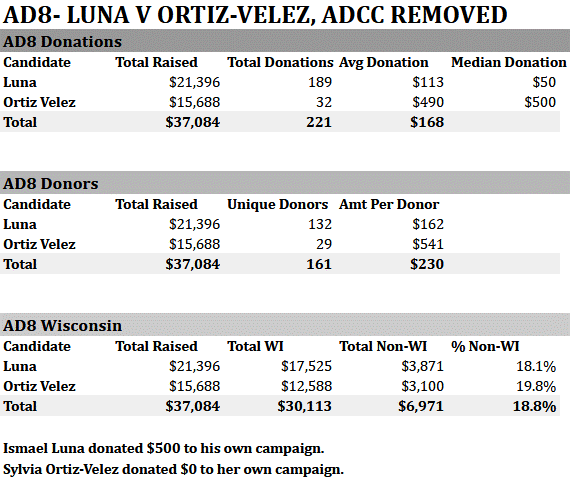
This is the one primary where the ADCC is backing a candidate who isn’t the more conservative one, and it took some really extreme circumstances to bring that about: Sylvia Ortiz-Velez voted with Republicans, refused to caucus with Democrats, and threatened to shoot some of them. So now we know, that’s what it takes for Minority Leader and ADCC chief Greta Neubauer to support a progressive in a primary.
The people supporting Ortiz-Velez include the Milwaukee Police Association (who also support Trump, and fascism generally), $9,000 worth of realtors and private equity groups, and some other conservative Democrats. Tim Carpenter, for example, is going hard for Ortiz-Velez, donating $1,075.31 between himself and his campaign committee.
Ismael Luna is an excellent candidate, who we are very excited about. He outraised Ortiz-Velez even without the $92,000 from the ADCC. His other money comes from education and service sector unions, progressive politicians, and supporters. It makes sense that the ADCC would want to help ensure that a fake Democrat like Ortiz-Velez couldn’t leverage her realtor connections and money to remain in office, but pouring almost $100k into the race feels like overkill. It might risk undermining Ismael Luna’s legitimacy and drive division in the Latino community on Milwaukee’s southside.
This feels like a relatively low-risk but high-stakes race. Ortiz-Velez’s bullshit is widely recognized, but if she wins this primary, the seat will be already lost, because she is a de facto Republican running as a Democrat.
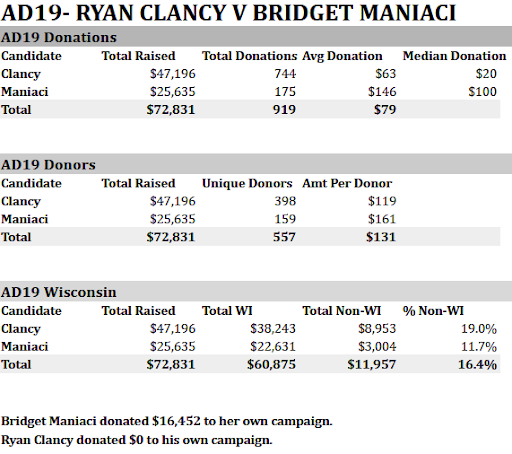
This race has moved from the top of my list of state legislative concerns to the bottom here because Bridget Manici is not a serious candidate. Her largest expenses on this finance report include a weird billboard she bought because not enough people want her yard signs, and a deceptive mailer implying that Francesca Hong endorsed her. In reality, Hong has not only endorsed her opponent, Ryan Clancy, but has been coordinating canvass launches with him since the very start of the race. Maniaci appears to have sent this mailer to a list of donors scraped off Hong’s finance reports (which would be a violation of election law). One of Maniaci’s few supporters is Wisconsin Elections Commissioner and genocide freak Ann Jacobs (who donated $500), so it’s unlikely Maniaci will suffer consequences for this action.
Maniaci spent $16,452 of her own money on this race. Unlike David Liners or Amy Donahue, who self-funded to give voters more ethical options, Maniaci and her backer Ann Jacobs seem to be on a personal vendetta rooted in anti-Palestinian bigotry. Many have concluded that they believe Ryan Clancy is responsible for Jonathan Brostoff’s death after he pushed away any friends who would not join him in supporting Israel’s acts of genocide after October 7, 2023.
Clancy’s top expenses over the years have been printing ($32,040) and supporting other Democratic candidate’s campaigns ($25,398). I hope Clancy beats Maniaci by a large enough margin that Ann Jacobs will finally quit recruiting people to run against him.
Congressional Races
Let’s shift to the Congressional races now. These contests have exceptionally high stakes because they could help flip the House of Representatives. A Democratic majority in the house would check Trump’s blatant fascist power grab, hopefully impeaching him and every member of his crooked cabinet.
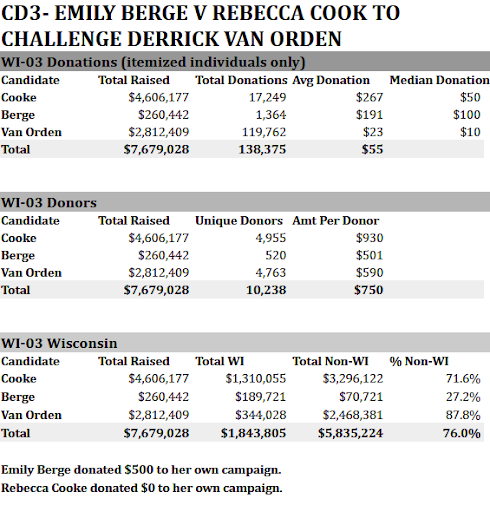
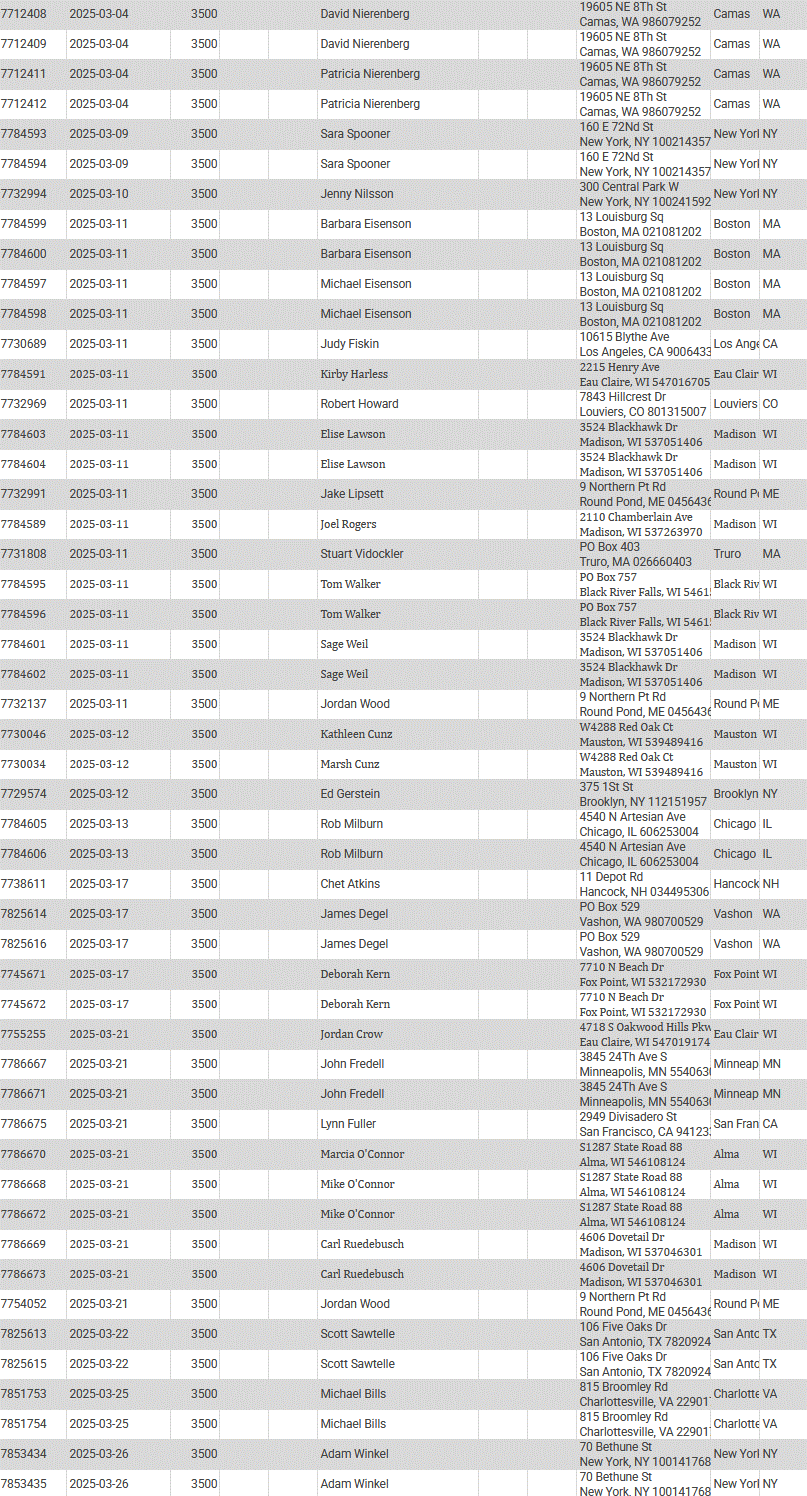
Unfortunately, in February, the Democratic Congressional Campaign Committee (DCCC, the federal equivalent of the ADCC) threw their support behind a candidate who has already repeatedly failed to beat Republican super-troll Derrick Van Orden. The DCCC kickstarted and nationalized fundraising for Cooke, resulting in a massive 71% of her funds coming from out of state, though Van Orden is even more heavily dependent on out of state money (87%). Cooke is also refusing to release her personal financial disclosure until after the primary. Her in-state donor list reflects her values as a pro-business “blue dog” Democrat. It’s chock-full of wealthy elites. The Lubar name shows up 13 times, for example. Cooke has also been endorsed by other pro-genocide Zionists.
Here’s where shit gets weird. There aren’t 13 Lubars. Many of these entries appear to be duplicates. As we said at the top, we’re not experts, but it sure looks like Cooke made the same mistake that tanked Lt Governor Sara Rodriguez’s campaign, counting many of her top donations twice. Did we miss a corrected report, or is Milwaukee Beagle breaking this story? We can’t be the only outlet that looks at these finance reports, can we?
NOTE: further investigation found that many of the below described double entries are because the FEC allows donors to give $3,500 for the primary, and $3,500 for the general. So, they are actually two donations, not Rodriguez style double-counting.
I am also confused about why Cooke’s opponent, Emily Berge, hasn’t gotten the national attention that other left Congressional candidates challenging the establishment have gotten. Berge is endorsed by Wisconsin Citizen Action and the DSA chapter in LaCrosse, but weirdly, Bernie Sanders has gotten behind Cooke, much to the chagrin of local socialists. Berge also doesn’t seem to be getting recognized or boosted by left-populist podcasts, pundits, or organizers the way other progressives and socialists are. Though, what would you say if I told you that Dave Matthews gave her $3000?
Assuming some professional reporters can clarify these numbers and Cooke’s campaign doesn’t implode on the eve of the primary due to bad accounting, it looks likely we will be left hoping national anti-Trump trends allow Cooke to finally beat Van Orden, rather than just getting close again. It’s hard to imagine Berge overcoming the DCCC’s incredibly heavy golden thumb on this primary.
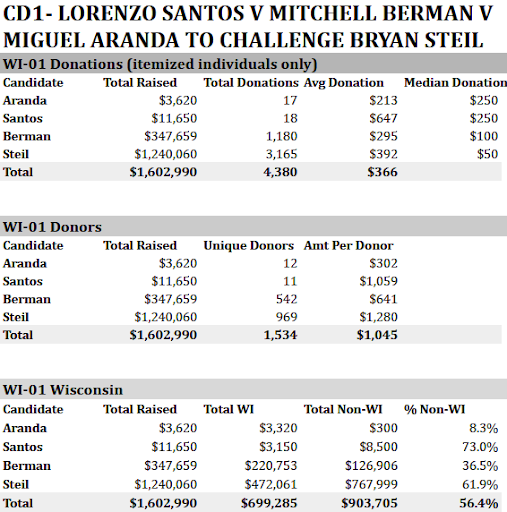
It’s hard to say anything about this race other than that the stakes are just as high as in CD3, but the primary does not appear to be close. VA nurse and progressive Mitchell Berman is the only candidate putting up the kind of numbers needed to be taken seriously in a contest with Bryan Steil. People I trust seem to prefer Santos, but unless something is screwy with the FEC reports, he’s only gotten 11 people to open their wallets, and most of them are from out of state. That’s just not going to cut it.
Other than one Lubar giving him $250, there doesn’t appear to be anything particularly damning against Berman in this finance report, but he is going to need to up the hustle if we’re going to take a serious shot at Steil.
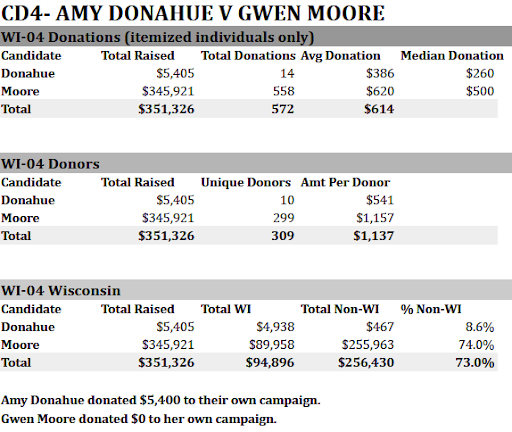
This is a longshot race, but with no serious Republican opponent, the calculation of the stakes are different. If Donahue’s support for Medicare for All, ending arm sales to Israel, and taxing the ultra-rich can defeat Gwen Moore, they’ll have no trouble beating the perennial Republican candidates who always run in this deep blue gerrymandered district. If Donahue doesn’t win, they will have put pressure on Moore to step up.
She needs that pressure. Her finance reports are funny-looking. Moore spent most of the money she brought in, but doesn’t seem to have spent it campaigning, at least not in Wisconsin. Her top expenses are to a DC consultant named Chris Trull (more than $254,390 over 216+ transactions), an American Express card (more than $133,900 over many transactions), her sister Brenda ($88,000 over 36 transactions), a Napa Valley winery ($8,083), and various hotels across the US. Back in 2023, Dan Bice wrote an article about Moore’s lavish spending from her leadership PAC but it seems like that exposure was not enough to get her to stop.
Most of her money (74%) is coming in from outside of Wisconsin, and she also gets a lot from insurance and healthcare related PACs, which probably explains her backing off on Medicare for All.
Amy Donahue probably does not have enough money or name recognition to beat Moore, but hopefully by running, Donahue is shining light on Moore’s genocide denial, corporate influence, and dearth of actual progressive credentials.
In Conclusion
It is very late Sunday night / Monday morning as I write this. The primary is so soon!
I am not a professional journalist, but I think there are some useful insights in these finance reports. I’m glad to share them, hope I didn’t make any devastating math or copy-paste errors (apologies if I did), and wish I had time to look into more donors or a couple more races (AD50, and AD12, particularly).
I hope to revisit this data after the primary, and again after the general (would love some help if any math kids are interested). I think there is a strategy question around the power of donations versus volunteer enthusiasm. Many of these races involve a poorly funded left populist candidate going up against loads of establishment money. I hope enough populists make it through the primary to serve as convincing case studies. Comparing the funds spent per vote won (in both the primary and the general) between these two types of candidates will be interesting.
My hope is the data will convince more Democrats to pressure the SSDC and ADCC. We need them to stop spending money against Democrats. If they stayed out of primaries and just let constituents pick their nominees, then their loads of money would be available to spend against Republicans and help those people-chosen candidates win in November.