It’s been more than a week since the blue tidal wave crashed across the United States, heavily rebuking Trump, the oligarchs, and end times fascists. Here in Wisconsin, this wave included Democrats winning their first trifecta since 2008, giving Democrats control of the governorship, the State Senate, and the State Assembly. Democrats didn’t just win, they walloped.
Since the election, I must admit I’ve done my fair share of libbing out. The blue tsunami is bigger than expected. These results might even foretell a political realignment in the US and a long-awaited end to the Republican era. If voters continue to turn away from the false promises of right populism, and toward true left-populist alternatives to elite capture and managed decline, then determined organizers could make this wave election into a generational paradigm shift for the United States.

For that to happen, we need the Democratic Party to persist in offering a left-populist choice. That’s why I’m not just libbing out, I’m also organizing. I helped pull together Wisconsin’s first WRENCH, short for Wisconsin Rejects Non-Action Constituent Huddles. That event was a roaring success, with more than 400 participants across the state in person and online. If Tuesday, November 3rd had me libbing out, Tuesday, November 10 had me digging in. On the third, we ate the Republicans’ lunch. I was worried too many of us would be satisfied with that alone, but on the tenth, I learned I am far from the only one hungry for more!
Unfortunately, our leaders do not appear to be with us. Instead of seeking maximum gain, Wisconsin’s Democratic leadership is already trying to lower expectations, look for excuses to do less, and prop up Republicans even as the GOP digs in their heels. The electorate righteously denied Democrats’ excuses. In this article, I want to linger on our victory and get a deeper picture of the mandate Wisconsin voters gave Democrats and the true scope of the gains we could realize from it.
State Senate
Wisconsin Senators serve four-year terms, with odd and even-numbered districts taking turns going up for reelection every two years. It therefore took two cycles for every seat to have a race with new maps that are at least somewhat more fair, although they still favor Republicans because Tony Evers is a bipartisanship simp. These changed maps complicate historical comparison. I am relying on Marquette researcher John Johnson’s data for comparing 2026 and 2024 results. The financial data I’m citing also comes from his site which only includes the 2026 fall pre-election reports (Jan 1- Oct 19, 2026). There was likely late money and dark money also impacting these races, so my financial impressions should not be read as conclusive.
I’m also taking Tammy Baldwin’s 2024 performance as a baseline rather than the presidential election, because we all know that Joe Biden and Kamala Harris fucked up and their campaign should be treated as a very dumb abberation, not an indicator of normal Democratic performance. Democrats will never allow a thing like that to happen again, right? Please? Fuck.
Over the last two cycles, seven of Wisconsin’s 33 State Senate seats flipped from red to blue, giving Democrats a three-seat lead. This year, the four close races we won also came with much bigger margins than wins in 2024.
12% swing in SD31 where Jeff Smith retained his seat with a margin of 16.8% compared with the 4.8% Democratic lean. Low candidate quality contributed to this rousing victory, because his opponent was a likely carpetbagger with a silly last name: “Magadance Skinner.” She did spend nearly twice as much as him, though.
9% swing in SD5 where Robyn Vining flipped a seat left open by Rob “too-conservative- for-the-Republicans” Hutton. Her margin was 14%, compared with 5.0% Democrat lean. Vining significantly outraised her opponent, but underspent him, showing confidence in her chances.
8.1% swing in SD21 where Trevor Jung took a seat left open by a bootlicker and cheat named Van Wanggaard. Wanggaard likely knew he could not win without his crooked maps, but Jung didn’t just take his seat, he won by 10.4% compared with the 2.3% lean. Spending was also fairly close in this race.
2.9% swing in SD17 where Jenna Jacobson took out incumbent Republican Howard Marklein, despite depending on the deep pockets of unlikeable donors to win her primary. That donor dependency might explain why she is the only person on this list with a single digit margin (of 7.6%) even though her district leaned 4.7% blue. Jacobson also outraised Marklein, but he spent $700,000 more than he raised, only to lose. That’s gotta sting.
In 2024, the Democrats gained four seats, but the largest margin was smaller than the smallest margin this year.
SD18, Kristin Alfheim won by 6.6%.
SD30, Jamie Wall won by 5.1%.
SD14, Sara Keyeski defeated incumbent Joan Ballweg by 2.3%.
SD8, Jodi Habush Sinykin defeated half-incumbent Duey Stroebel by only 1.5%.
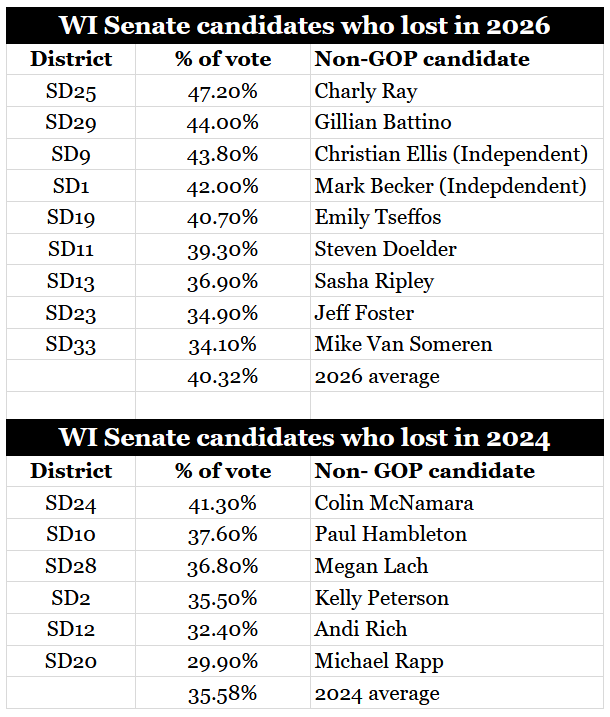
This is a trend that could continue. Democratic challenger Charley Ray even got within spitting distance (5.6%) of defeating Erik Severson to flip District 25, where Baldwin lost by 10.8% in 2024. Dan Schafer at Recombobulation Area rated the race likely Republican on election night, and safe Republican up until a few days before. If we compare all races where Republicans won, we see that in 2026 even the Democrats who lost got a 4.7% larger vote share (40.3% v 35.6%) on average than in 2024.
State Assembly
Before the election, pundits and pollsters were saying the Assembly was the piece of the trifecta most likely to stay red. Instead, voters exceeded expectations even more, with strong swings left everywhere in the state. Democrats rode those swings to victory in these eight races.
27.8% swing in AD21, where Dan Bukiewicz stomped secret TPUSA clown Dylan Pfaffenbach (by 25%). Bukiewicz is a data center darling who relied on dirty tricks and piles of money to win the primary against socialist David Liners. Dan Schafer saw this coming and called it lean Democrat early on even though the seat went Republican in 2024. Bukiewicz dramatically outspent Pfaffenbach, ($284,000 to $33,000 as of October 19). I’m still mad about this primary, because the piles of money Assembly Speaker Greta Neubauer and other Democratic establishment figures spent against Democrats Jessica Seawright and David Liners. That money could have been saved for later and spent against Republicans, likely winning some of the close races listed in my next section. Seawright or Liners would not have needed so much money to secure this win, and they would not be bringing Bukiewicz’ data center and reactionary unionism baggage into our assembly caucus.
15.6% swing in AD61, where Ben Brist finally took out clown-punching weirdo Bob Donovan, by 12.4%. Schafer had called it a toss up because in 2024, Donovan won by 3.2%. Brist raised $64,000 more than Donovan, but Donovan spent more than he raised, desperate to hold on to his slimy grifter–or to hear him tell it, lone wolf–identity.
14.7% swing in AD85, where John Kroll defeated incumbent Patrick Snyder, by 8.2%. In 2024, Snyder won by 6.5%, and Schafer marked this race lean Republican, so it is a real upset. Kroll did raise and spend around twice what Snyder did to make it happen.
14.5% swing in AD30, where Kevin Knoke defeated incumbent Shannon Zimmerman, by 6%. In 2024 it went to Zimmerman by 8.5%. Similar to AD85, Schafer marked it lean Republican and many expected Zimmerman to win. Also like Kroll, Knoke raised twice what Zimmerman did, though Zimmerman spent far more than he raised.
14.3% swing in AD51, where Ben Gruber took out persistent thorn Todd Novak, by 10.9% (an economically populist, but socially conservative 3rd party candidate also got 1.6%). Schafer called this a toss up because Novak won by 3.4% in 2024, despite the district leaning blue. Gruber raised and spent nearly double Novak, though.
13.4% swing in AD92, where Jeremiah Fredrickson defeated incumbent Clint Moses, by 6.8%. Moses won here in 2024 by 6.6%, so it’s another upset. Spending was also pretty evenly matched.
10.6% swing in AD53, where Becky Nichols defeated Republican David Daniels and conservative independent Rachel Dowling (who managed to get 6.3% without any party to support her). The district leaned blue in 2024, but retiring Republican Dean Kaufert narrowly won (1.2%). If we just compare Nichols and Daniels, she won by 17.2%. But, we should probably assume most of Dowling’s votes were taken from Daniels. Nichols still beat them combined, by 9.4%. She did raise and spend dramatically more than Daniels ($135,000 vs $28,000).
9.3% swing in AD88, where Brandy Tollefson took out incumbent Ben Franklin, by 8.6%. Schafer called it a toss up, because Franklin previously won a narrow 0.7% margin. Tollefson raised and spent well more than double Franklin.
Democratic challengers also got closer than expected in six more races that unfortunately stayed Republican. On the bright side, they all became much more competitive this round, and might be future battlegrounds. Five of them are in suburbs around Milwaukee.
In Waukesha:
12.1% gain in AD82, for Democrat Rico Camacho, who got within a few percentage points of winning (the district went Republican by 14.5% in 2024). This was despite Republicans running the more moderate Bryson Reyes instead of arch conservative incumbent Scott Allen, who chose not to run after losing the Waukesha mayoral race to liberal common council president Alicia Halvensleben. Reyes spent nearly double Camacho. Seems Democrats could have benefitted from smarter ADCC leadership here, because it may have cost a fraction of what they overspent on other races to secure a win for Camacho.
8.5% gain in AD15, for Democrat Stephen Tryon, whose 9.8% deficit against incumbent Adam Neylon cut Neylon’s prior 18.3% margin nearly in half. The incumbent Republican is also running for Waukesha County Executive in December. If he wins, Democrats may have another shot at this seat. If his opponent Senator Chris Kapenga wins, that will open Kapenga’s harder-to-win seat to a special election instead. Tryon raised more, but spent less than Neylon, which might mean he’s got a start at that second swing.
In Milwaukee’s North Suburbs:
11.8% gain in AD24, where Matt Brown closed a massive 20.0% gap against incumbent Dan Knodl to only 8.2%. Knodl outraised Brown by more than 3 times, and outspent him by nearly 10 times. This one’s finances definitely deserve more examination.
9.9% gain in AD22, where Dana Glasstein closed a 16.1% gap to only 6.2% against a Republican incumbent Paul Melotik. Glasstein both outraised and outspent Melotik.
South of Milwaukee:
7.2% gain in AD63, where Eddie Phanichkul got within 7% of taking out Republican incumbent Robert Wittke in this district which includes Franklin and Caledonia. In 2024, Democrats didn’t put up a challenger, but Trump won by 14.2%. Wittke raised four and a half times more money, and as of October 19, spent eight times more money. During this race, Phanichkul was dealing with a lot of bullshit as a member of Milwaukee County Dems executive board while also running for office, which surely hurt his operation. Less internal drama and better distribution of funds from Democrats might have made this race a winner.
What this could mean
There are a lot of numbers here, and I am not a numbers guy. Milwaukee Beagle is seeking “matha-mutt-icians” who might help draft a follow-up that crunches and presents this data in a more legible way, especially with more complete financials. That will add detail and certainty to my conclusions.
In the meantime, all I can say is it really does look like Wisconsin voters responded to decades of Republican corruption, cruelty, stinginess, and anti-democratic aspirations under gerrymandered maps with a fierce rebuke. This is not just a manifestation of national fundamentals, as GOP Chair Brian Schimming tried to claim, but a specific and large mandate from Wisconsin voters. It is an opportunity for Democrats to deliver affordability, and lock in long-term compassionate, generous, and effective governance in this state. To do so, they need to stop making excuses and propping up their Republican opponents. Most importantly, they need to shed their ties to the elites who will try and obstruct an affordability agenda, and to Islamophobic bigots who support genocide.
If Democrats act right the next two years, Wisconsin could become a reliable blue state long-term. Democratic leadership’s behavior so far suggests that we are going to have to make them act right, to wrench the affordability agenda out of them. If we do, Wisconsin could be a harbinger or bellwether for a deeper national realignment.
We are in some exciting fucking times here, folks.